
The technology
No combustion. Just electricity.
aSOFC with Nanocrystalline Electrolyte: fuel is split at the molecular level and becomes electricity — at up to 92% electrical efficiency on gas (LHV).
0%electrical efficiency on gas (LHV)
Inside the cell
From fuel to electricity.
Three things happen inside every kraftwerk TUBE — none of them is combustion. Scroll through them.
01 — Fuel in
Fuel meets the anode.
Hydrogen, methane, methanol or diesel flows through the 38 mm ceramic tube. Nothing is ignited, nothing burns — the fuel simply arrives at the inner layer.
02 — Ions cross
Only ions get through.
Oxygen from the air on the outside becomes oxygen ions. The nanocrystalline electrolyte conducts them through gas-tight ceramic at 450–600 °C — where a conventional solid oxide cell needs more than 800 °C.
03 — Electricity out
The electrons run around the outside.
What the electrolyte blocks are the electrons. They take the long way round, through the circuit — and that detour is the electricity. What is left is water; CO₂ only with carbon fuels.
One reaction instead of a combustion — that is where up to 92.0% electrical efficiency on LNG/CNG (LHV) comes from, 82.4% on liquid fuels.
Schematic drawing of the working principle — the layer order is real, the layer thicknesses are not to scale.
The innovation
aSOFC with Nanocrystalline Electrolyte.
The Electric Power Cell™ is a hybrid of solid-state battery and fuel cell. Its heart is the nanocrystalline electrolyte — reduced operating temperature, start-up in under 3 seconds (prototype), <1 ms dynamic response when warm.
Solid-state
An oxygen-ion-conducting solid electrolyte — oxygen ions travel through the nanocrystalline ceramic.
Unlike lithium batteries
Durable, safe, fully recyclable — >80,000 h, no charge-cycle degradation.
Unlike conventional fuel cells
Not bound to hydrogen — it runs on many different fuels.
No combustion
One reaction turns fuel into electricity — near-zero NOx, SOx and particulates at the point of use.
up to0%
electrical efficiency on gas (LHV) — measured, not promised
Inside the wall
Three layers. 38 millimetres.
A kraftwerk TUBE is the size of a matchstick and weighs about a gram. Its wall carries the whole technology — three ceramic layers, one of them the innovation.
Cathode — air side
Porous outer layer. Oxygen from the ambient air enters here.
Nanocrystalline electrolyte
Gas-tight ceramic — the innovation. It conducts oxygen ions at 450–600 °C instead of the >800 °C a conventional solid oxide cell needs.
Anode — fuel side
Porous inner layer. The fuel flows through the 38 mm tube and reacts here.
Schematic drawing — not a micrograph. Layer thicknesses not to scale.
How the layers are made
Ceramic, layer by layer.
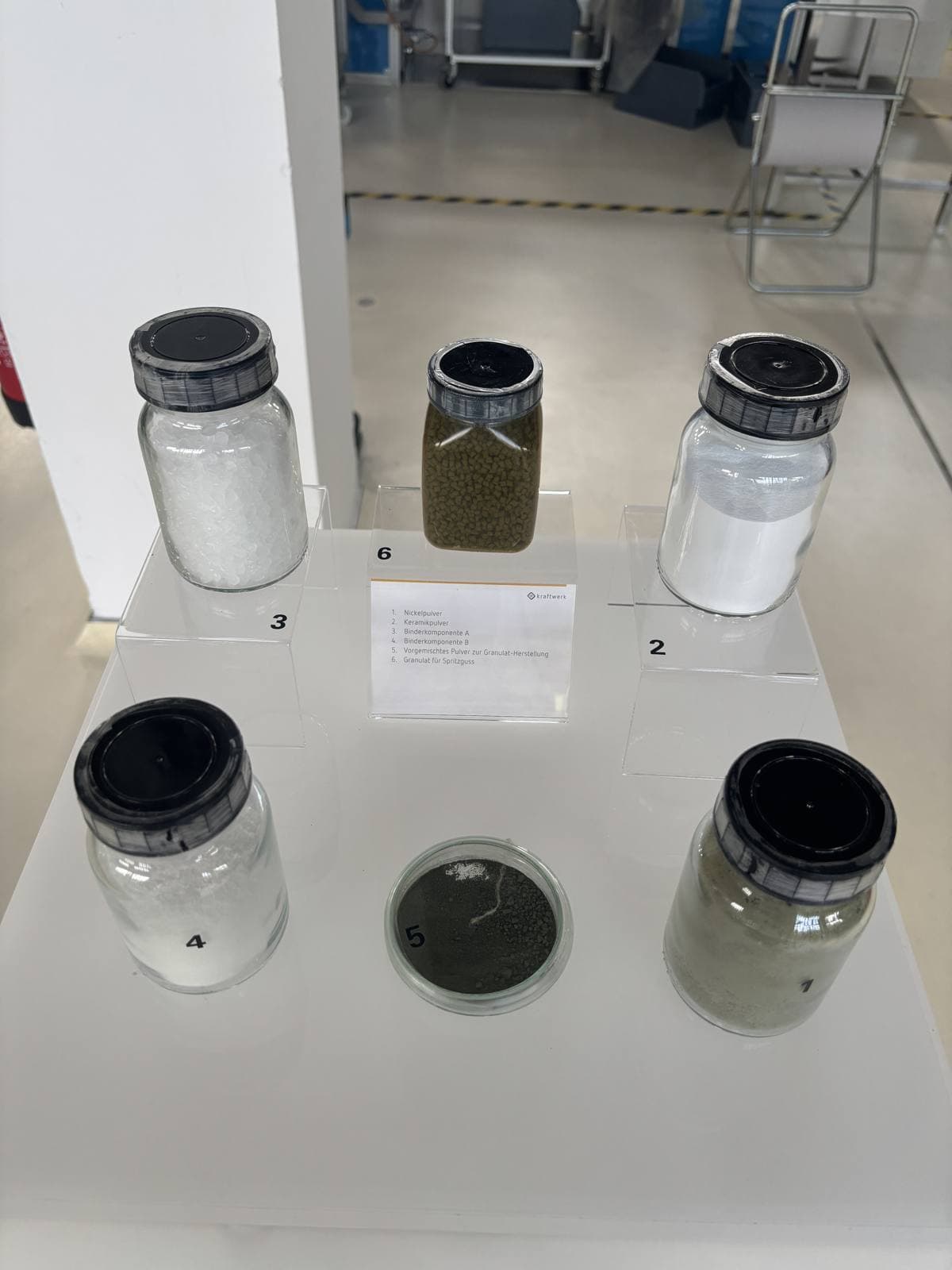
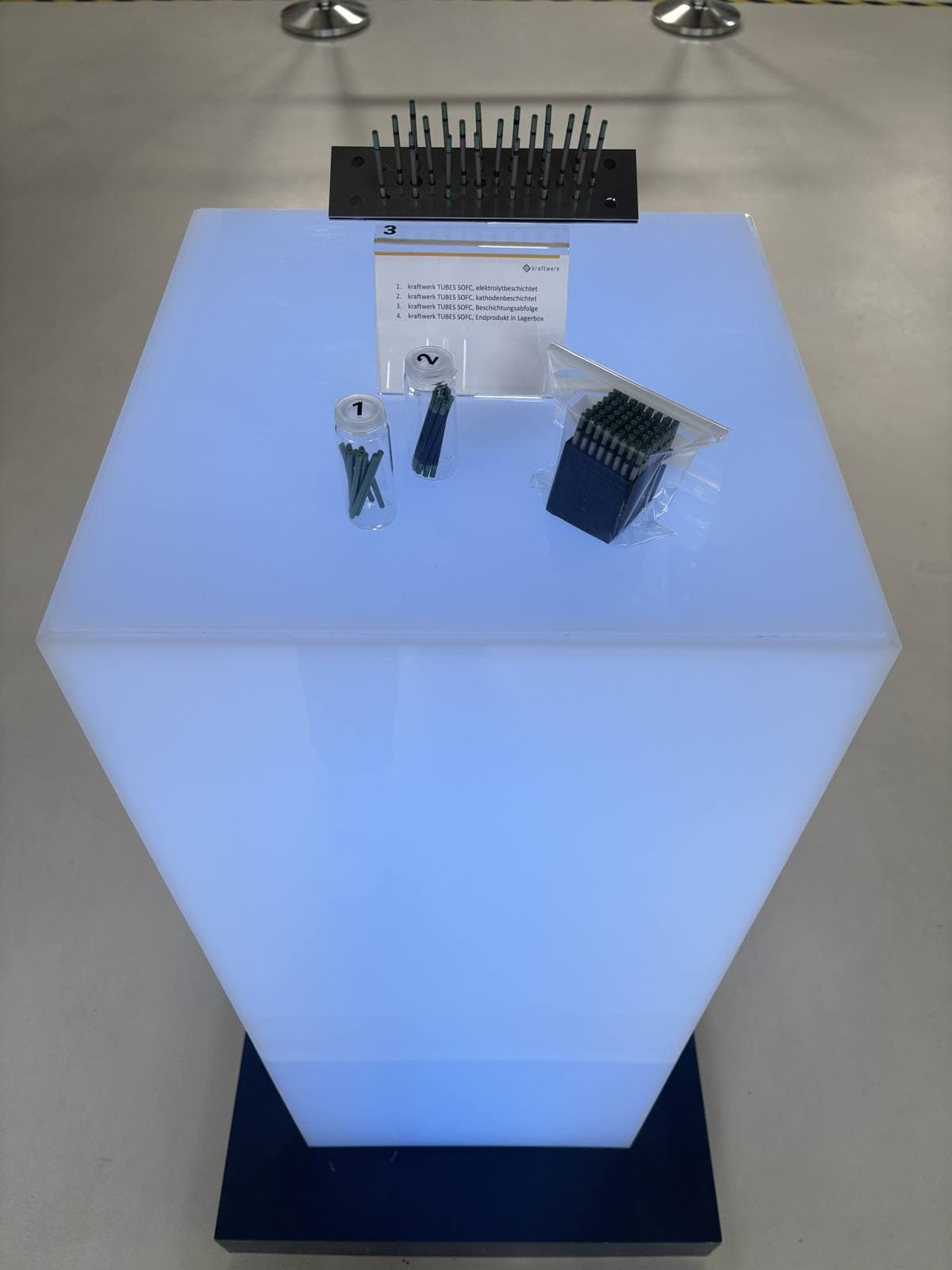
No renders here — this is the Dresden line where the layers of every cell are actually coated.
Real footage
Filmed, not rendered.
Inside the cell on camera — and the Dresden test stands where every cell delivers real measurement data.
Multi-fuel
One platform. Every fuel.
Hydrogen, methanol, ammonia, diesel — and virtually any hydrogen-carrying fuel, including the fuels of tomorrow.
Compatible with existing fuel infrastructure. CO₂ occurs only with carbon fuels — and is captured in the closed loop.
And what is NOT inside:
3
Li
Lithium
mining-intensive
not used27
Co
Cobalt
critical supply
not used78
Pt
Platinum
precious metal
not used57–71
RE
Rare earths
scarce
not used✓
Cer
Ceramics
abundant
Head to head
One table. Four technologies.
The aSOFC against lithium-ion batteries, PEM fuel cells and conventional solid oxide cells.
| Criterion | kraftwerk aSOFC | Lithium-ion battery | PEM fuel cell | Conventional SOFC |
|---|---|---|---|---|
| Electrical efficiency | Up to 92.0% on LNG/CNG (LHV) · 82.4% on diesel & liquid fuels · 74.8% on hydrogen & ammonia | Stores energy — doesn’t generate it | ≈ 55–74% | High — SOFC-typical |
| Fuels | Multi-fuel — hydrogen to diesel to ammonia | None — grid electricity only | Hydrogen only | Multi-fuel capable |
| Precious & rare materials | None — no lithium, cobalt or platinum | Lithium, cobalt, rare materials | Platinum | None |
| Weight per 100 Wh | 1 g cell · ~10 g system | 355 g (Tesla 4680 cell) | — | Heavy stationary stacks |
| Degradation | >80,000 h — no cycle degradation | Fades with every charge cycle | — | Fragile under thermal cycling |
| Refuel / charge time | 2-minute refueling | Long charging stops | Minutes — hydrogen only | Slow start — stationary duty |
| Infrastructure | Existing fuel infrastructure | Charging-grid build-out required | New hydrogen network required | Pipeline gas, stationary sites |
kraftwerk figures from the completed TRL 7 validation program and the product datasheets, which we share on request.
Energy density
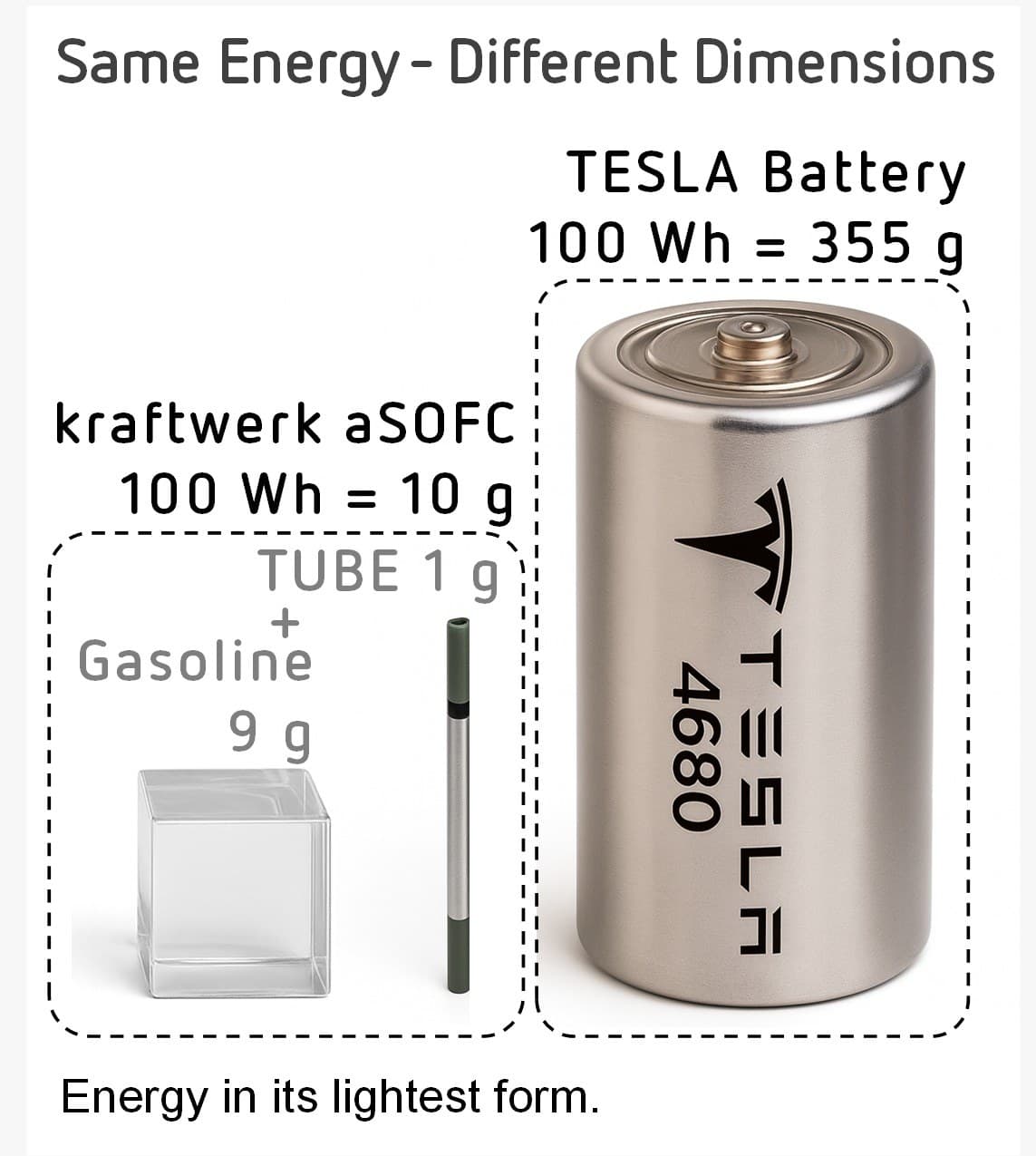
Same energy. Different dimensions.
100 Wh of energy — carried by a cell, a fuel, or a battery.
~0 g
kraftwerk TUBE, system level (1 g cell)
0 g
gasoline
0 g
Tesla 4680 battery cell
A fair comparison: the TUBE converts energy, a battery stores it. Even counting the fuel — 9 g of gasoline per 100 Wh — the system stays an order of magnitude lighter.
Validated
Not a lab promise.
TRL 7 completed — validated with an automotive OEM in a relevant environment.
TRL 0
technology readiness — program completed
0
patents granted, more filed
0 km
test vehicle on a single tank — 5 years of proof of concept with the Volkswagen Group
Vetted and funded by the European Innovation Council.
One of 10 EIC-backed companies at the EIC Corporate Day 2026.
EU grants 817161 · 859655 — kraftwerk TUBES GmbH
Winner of the EGYPES Climatech Challenge 2025 in Cairo. Read our full story →
Datasheets
The numbers, on request.
The full datasheets for the 1 MW BOX and the SURFBOARD™ 30 are not a public download. We send them after reviewing the request — tell us who you are and what you are planning, and you will have them.
kraftwerk BOX — 1 MW Container
1,000 kW net power, multi-fuel, 5-minute cold start, >80,000 h lifetime — with the full specification table.
SURFBOARD™ 30 — Mobility Module
200 kWh per tank module, 2-minute refueling, 1,528 PS peak system power — with the full specification table.
Next step
See the technology at work.
From a 1 MW container to vehicles with up to ~1,500 km per tank module — same cells, different scale.